
Looking to implement C2PA? Trufo provides tooling to take care of everything from certificates and timestamping to watermarking and fingerprinting. Learn More
Trufo wordmark

A Brief Introduction to Content Provenance and Content Credentials

what C2PA Content Credentials are and why they work
v2025.10.09
With the rapid advancement & proliferation of generative AI comes a flood of synthetic media that is increasingly realistic. Take the now-classic example of Will Smith eating spaghetti:
original version, 2023
made with Veo 3, 2025
This has profound implications---namely, that unless something is done, it will soon be impossible to tell what is real from what is fake. Governments are now codifying this concern into law: see our EU AI Act compliance guide for how Article 50 and parallel rules in China, the US, and Korea require AI-generated content to be labeled.

Bear photo 1
Bear photo 2
Think you know which one is real? Click to reveal.
For companies, this means that brand reputation now needs to be protected. For AI labs, this means that training data quality now needs to be preserved. For society, this means that the trust and truth we rely on now needs to be defended. And these actions must be taken at a larger scale than before.
What is Content Provenance?

The key to addressing this risk posed by generative AI is content provenance.
Provenance: the set of facts we can determine about an item of content.
For example, if by watching a video we determine with our own eyes that whether it is AI-generated or camera-captured, we are making a judgement on provenance. There are actually a subreddit dedicated to this ever-more-demanding task!
r/RealOrAI
A subreddit dedicated to the challenge of distinguishing AI-generated content from real media. Test your skills and see how good humans are at detecting synthetic content.
Visit reddit.com/r/RealOrAI →
The value of content provenance lies not only in answering the "Real-or-AI" question, but also in the other facts tied to the content. For example, an official post by a celebrity or a live broadcast by a news agency carries more weight than a random social media post, just like how the value of art depends not just on the quality of the art but also on the identity of the artist.
For any organization that deals with digital content, there are two immediate business inquiries:
(1) How can we extract useful provenance from content?
(2) How can we use provenance to increase the value of our content?

Detection versus Labeling

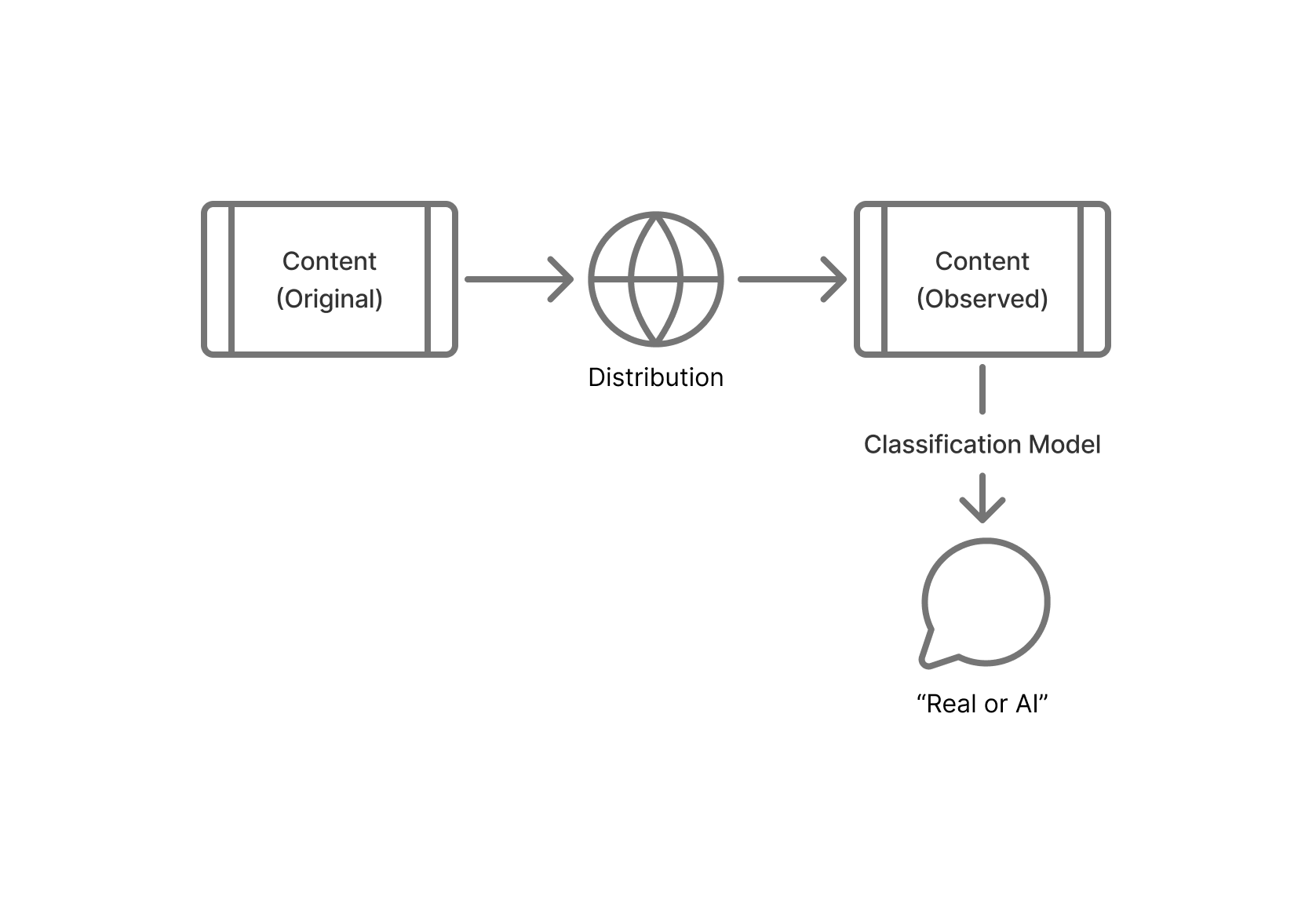
The most immediate solution is detection. Instead of manually processing content, an AI classification model is trained to predict whether content is "Real-or-AI" and to do so at scale.
Detection diagram
These models can be immediately used on any content, so even though their accuracy is limited (under 70% against top models), they are able to address business inquiry (1) in settings like fraud detection where the purpose of the solution is to act as a probabilistic filter. Here are two examples:
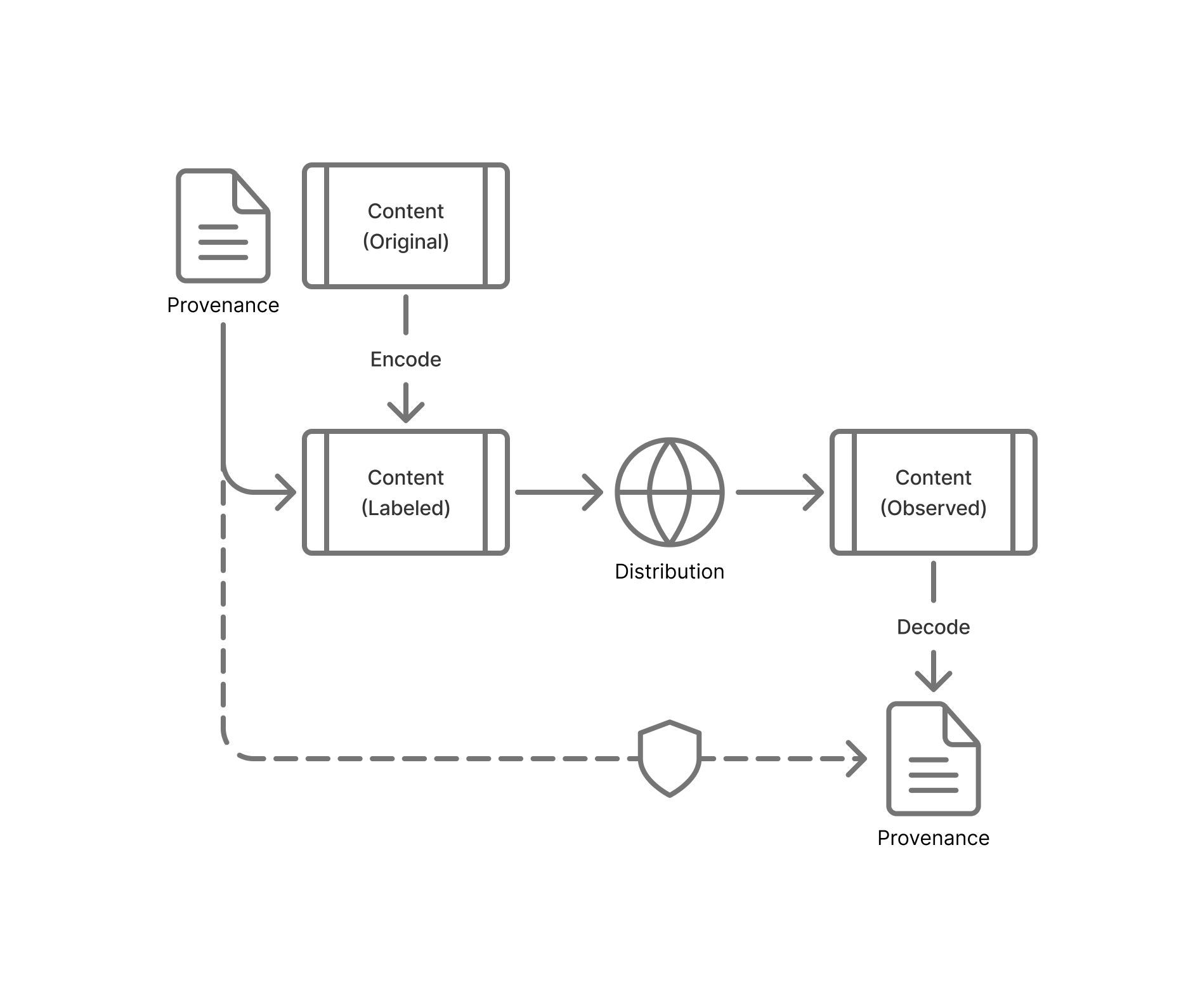
The long-term solution is labeling. By adding a deliberate step of labeling before publishing, the provenance of the content becomes far more powerful: more detailed, more reliable, more valuable. And instead of a probabilistic guess is a cryptographic proof.
Labeling diagram
There are two main costs this label-based content provenance solution: complexity and investment. Trufo can abstract away the complexity, but content producers still need to make the investment of adding that extra labeling step into their workflows. The good news is that this investment is already in full swing, with companies like Google (via Pixel 10) and OpenAI (via ChatGPT) and many others already plugged into an emerging global ecosystem.
C2PA
The Coalition for Content Provenance and Authenticity (C2PA) is an open technical standard that adds context and history to digital media, allowing creators to claim authorship and consumers to verify authenticity.
Visit c2pa.org →